The Quest for Definition
December 17, 2024
Wrestling with dharma through the Ramayana
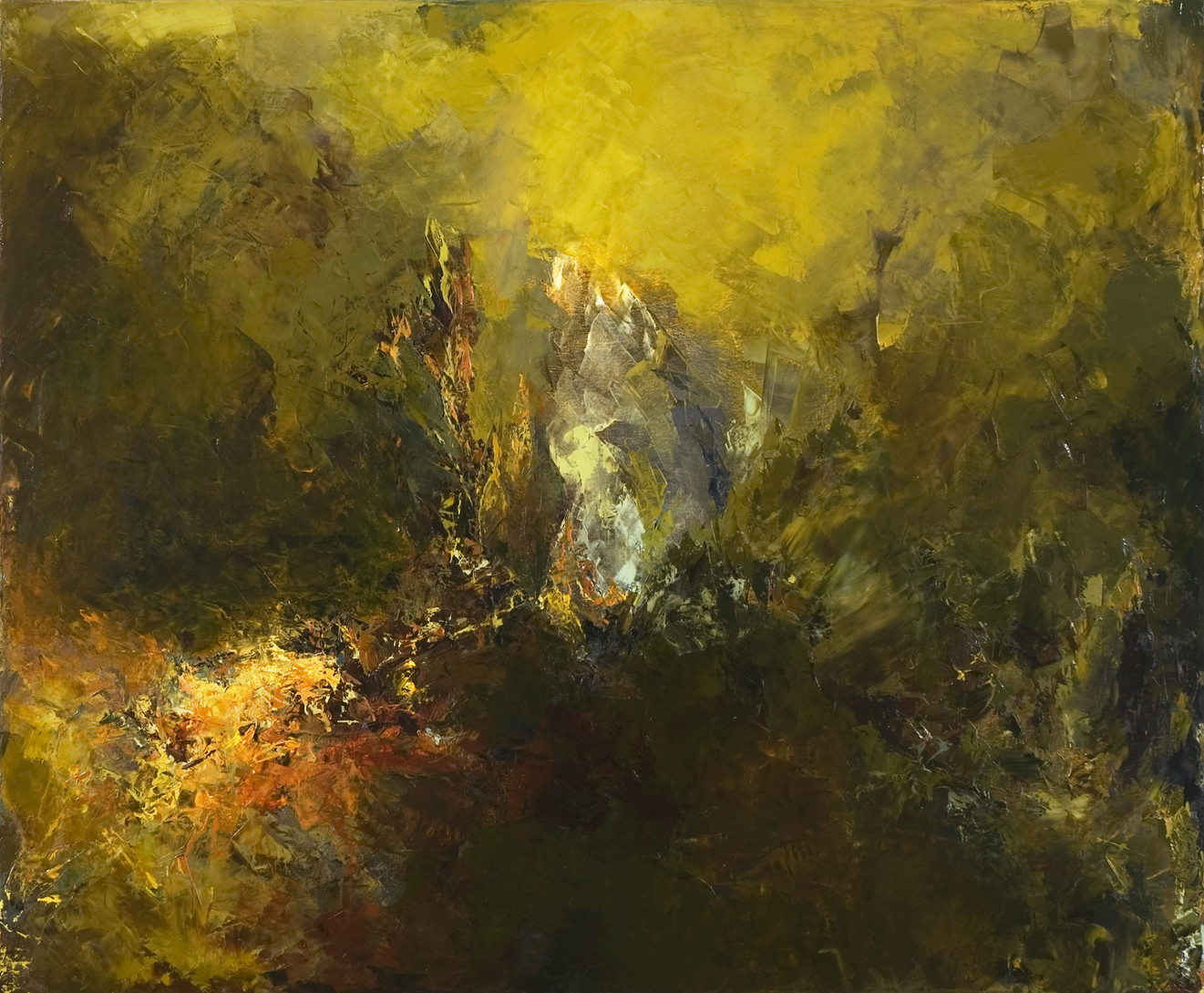
Ancestral Fire, oil on canvas, 38 × 48 inches
Artwork by Alice Zinnes
When I was in high-school, I did plenty of debate in the British Parliamentary style. Come my turn to speak, I would stand and find my way to my Humble Mantle of Persuasion – what other mere mortals simply refer to as the "podium." The first step was to define the terms of the proposition (the proposition being the thing that everyone's arguing about). Not out of personal choice: this was something required as part of these styles of debate. For example, say the proposition of the debate was:
"This House believes that freedom of speech should be unrestricted."
We could get annoyingly pedantic and define "believes," but – for both our sakes – let's not be that one kid. Now how about "freedom of speech"? One interpretation is absolute freedom of speech, the unrestricted right to express any idea without fear of censorship or punishment. Another is qualified freedom of speech, a right that includes limits to prevent harm, such as incitement to violence or the spread of dangerous misinformation. It would be a rather waste of everyone's time and space if the Government and Opposition (names for the two "sides" in fancy British Parliamentary lingo) each operated on different definitions, only to realize mid-way through that they were debating very different flavours of the same proposition. How ridiculous! In these moments, when I would walk up to my Humble Mantle, I wasn't just a teenager at a debate tournmanent, but rather the arbiter of meaning: someone single-handedly responsible for establishing the confines within which our warded wisdoms and whip-smart wits would clash.
But debate tournaments aren't the only arenas where definitions wield this kind of power. In the real world, there are always those who get to define the terms one way or another. From political icons to the equivalent iconoclasts, there are a handful that decide what words like "freedom," "justice," or "progress" functionally mean for the rest of us, the mob, and brandish these meanings to others. This power to name, frame, and define carries enormous weight, shaping the boundaries of what is deemed acceptable, moral, or just by the collective.
We see the consequences of this everywhere. A CEO might insist a round of layoffs is an act of "progress" to save the company, while employees lose their livelihoods. Politicians claim to stand for "freedom," but what kind? Freedom to vote? Freedom to exploit? Who knows…
This is precisely why ancient stories like the ancient Ramayana remain – perhaps surprisingly – relevant, even for someone who's never heard of it. Far from being just a dusty old epic, it dives headfirst into these same moral dilemmas: how people define what is "right" and how those definitions play out in situations where no choice is really the "definitely-correct-impossible-to-pick-anything-else-ever" option. For centuries, the Ramayana has been seen in South Asian communities as a guide for navigating ethical crossroads, but its questions – unbeknownst to the Average Joe or Jolene – are universal. Who gets to define what's right? And when the stakes are highest, how do you choose between competing obligations – to yourself, to others, and to the greater good? We too wrestle with these questions that the Ramayana inquisitively teases in parallel, but often behind the shadow of larger controlling systems that already seem to have already figured it all out for us – on our behalf, of course.
Kinda sucks, right?
Having others define the terms we live on.
...
Unless we're the ones defining the terms.
If not for others, at least for ourselves.
So let's define some terms!
This isn't about self-proclaiming ourselves as a maverick – it's about actively defining our own values. When we – especially unknowingly – adopt others' definitions of "right" and "wrong," we implicitly forfeit our innate power to determine how we will respond to the world around us. We permit external forces – be it instutitions or demagogues – to mould our views in ways that may not align with who we truly are or wish to be. But when we define the terms for ourselves – say what "freedom" means to us instead of subscribing to others' ideas – we reclaim this power.
Any who, instead of hearing me further pontificate, let's treat the Ramayana as a contextual and metaphorical battleground of sorts where – over the course of the next few minutes it takes to read this – we discover hazy moral dilemmas and have our reactive versus responsive judgements on these very dilemmas naturally wrestle with one-another. This is an opportunity for our moral opinions to spar with one another and help define our unique higher-level dharma. By the end, maybe we'll have a better sense of where we stand on the same "classes" of dilemmas and how we'd comport ourselves in such situations.
So I'll kick it off with a half-baked definition that we'll fill in for ourselves moving on.
Dharma:
Sanskrit: धर्म
Pronunciation: därmə/, dʱɐrmɐ
Definition: duty and righteousness
Rama
For those not familiar, there's a point in the epic where Sita, after being abducted by the demon king Ravana, is rescued by her husband-cum-king, Rama. But something's not really quite right after she's saved. There's a modicum of suspicion lingering around in the air; Rama says:
For surely, Sita, once Ravana had seen you, so enchanting with your heavenly beauty, he would not long have left you unmolested while you were dwelling in his house.— Goldman et al., Yuddhakāṇḍa, Sarga 103, Verses 22–25
When [Sita], who deserved to hear only kind words, had heard those cruel words of her beloved after such a long time, she shed tears and trembled violently, like a vallarī creeper struck down by the trunk of an elephant lord.
Despite Sita being hailed as the paragon of virtue by pretty much everyone including her husband, Rama fairly bluntly questions Sita's purity, claiming that she must've slept with someone else while she was kidnapped by the demons. By the way, Sita time and time again seems to virtually dedicate her every breath towards Ram, hosting an inexplicable level of idolatry for her husband – I would argue to a fault.
Even if my husband were utterly lacking in good behavior, my noble lady, still I would always obey him wholeheartedly. How much more readily would I obey a man praised for his virtues, a compassionate, self-disciplined, and righteous man, who is constant in his love, who defers to his mother and holds his father dear?— Goldman et al., Ayodhyākāṇḍa, Sarga 110, Verses 1–5
So, in a moment that's both tragic and, frankly, infuriating, Rama asks Sita to prove her chastity by walking through fire. She does so and – miraculously – emerges unharmed. The reaction is immediate: What a betrayal! How could a husband, someone who is supposed to protect and honor his wife, subject her to such a humiliating and dangerous test? It's not just an act of distrust; it feels like an abdication of his moral responsibility. Rama is supposed to be her protector, yet he seems to be endorsing an impossible, cruel standard of purity. Why did she even marry him? No excuses.
But, hear me out. Rama may not necessarily be acting out of malice or personal doubt; he's caught in a quandary where his duty as a king collides with his love for Sita. As a ruler, he's bound to the expectations of society. His people have witnessed her capture and his battle to rescue her. There's a pervasive doubt about her purity, and Rama, more than anyone, feels the weight of this doubt – not because of his personal feelings for her, but because as a king, he must maintain the moral and social order of his kingdom. Maybe this seems ridiculous to us, but defying this expectation would risk the unity and stability of his rule – and so for him, his near-absolute obligation towards his subjects is the very tragedy itself.
On the other hand, Sita is not just put on trial by Rama, but by society itself. She is forced to prove her worth based on wholly external standards. For her, the real tragedy isn't just the personal betrayal – it's that Sita has no agency in this instant. She is reduced to a symbol, her purity determined by an impossible standard, and forced to play by rules that she never really had a say in legislating in the first place – much like how members of the mob often aren't privy to defining the very ideological infrastructure they live in. While Rama's decision seems to be rooted in his own dharma, it is clear that this duty is shaped by a society that demands conformity, even at the expense of individual dignity. This mirrors the societal system we navigate in our own lives and even in this essay where we try defining terms for ourselves. It seems as though the autonomy inherent to making personal "choices" are heavily a function of the prevalent ideologies and expectations promoted by those in power or some personification of the collective.
Sita
Well, that's pretty sad. The first event we pulled from the epic arguably delegitimized our very endeavour here where we – initially empowered – set out on a quest to define terms for ourselves beyond the confines of society we live in, only to realize we're really restricted by the society we live in.
Later in the Ramayana, after giving birth to Rama's sons and being exiled from the kingdom (yes, Rama exiles her even after she irrefutably proves her chastity after the trial by fire), Sita faces a final, heartbreaking moment where she returns to the Earth.
When Sītā, who was clad in ochre garments, saw all those who were assembled, she cupped her hands in reverence, cast down her eyes, and lowered her face. Then she spoke these words: "As I have never even thought of any man other than [Rama], so may Mādhavī, the goddess of the earth, open wide for me.— Goldman et al., Uttarakāṇḍa, Sarga 88, Verses 9–10
Along the same vein, we could interpret this event not so much as an active choice on her part, but rather the only option she really ever had in a society – guided partriarchically by Rama – rejecting the world that has failed to accept her. One may put on a different pair of glasses and suggest she's reaffirming her purity – after all, her return to Earth could be seen as a final act of self-validation. Perhaps in a sense, she's "proving" that she is above the human world, untouched by the doubts and injustices cast upon her. But either way, she's pushed into a corner by the very society she lives in, teleporting us back to the suffocation we felt earlier when realizing the tight bounds of the ideological fabric we don't have the privilege to define in our society.
It doesn't have to be this way, though. Let's say Sita's return to Earth is much more than an act of purity, which is exactly what the townspeople and Rama have been vying for all along really for their own collective moral conscience. It's an act of defiance where she rejects the world and the systems that have pushed her into this very corner, made her prove her externally-defined worth time and again, and robbed her of her own agency. By choosing to leave the human world, she not only implicitly builds her own true identity, but also asserts her inalienable right to define her own terms – even if those terms don't align with the expectations placed upon her.
No matter whether we believe Sita was rather sadly "just" reaffirming her purity or actively rejecting the society she belonged to, the common denominator is that her actions are still heavily influenced by the terms society has defined and the previously mentioned "ideological infrastructure" regarding what is socially acceptable. Despite this, I would venture to say that it is this very friction between Sita's personal definition of dharma and that projected on by the society arround her – including her own husband who she glorifies – is deeply reassuring, if not empowering, to the average person who finds themselves in a similar journey of self-realization. Once again, this friction is not satisfying for some corrupt, autotelic bohemian reason, but rather because of the profound collective humanity it reflects. It speaks to the all-too-familiar universal struggle of reconciling external expectations with internal convictions. By even daring to define her own terms, even within the constraints of her world, Sita offers us a blueprint for self-realization: not by cavalierly rejecting the systems that shape us outright, but by finding ways to discover our identity and values within them.
Well, okay…
After reading this essay, maybe what I'll say now will make you roll your eyes and sigh in grief, but if debate taught me anything over the years, it's that defining terms doesn't ever solve the problem – it just parameterizes the battle. The best we can do is simply make a decision and accept that life will always present us with new "propositions" (haha) to wrestle with. It is irrelevant whether there is some external ideological scaffolding we are confined by; the truth of the matter is that time always moves forward and we'll have to take actions and make decisions, one way or another. If there was some metric to measure self-worth – agnostic of any specific human circumstance – it would be whether we have the courage to keep learning about the world we live in, choosing what we think is best for us, and consequently growing with each new challenge. In, perhaps, simpler terms, it is the suffering and struggle associated with self-realization – that is, our individual quest to define our own dharma – which truly defines us.
Dharma:
Sanskrit: धर्म
Pronunciation: därmə/, dʱɐrmɐ
Definition: to be determined…
References
Goldman, Robert P., et al. The Ramayana of Valmiki: The Complete English Translation. Princeton University Press, 2016.