Collaborated with Marc Schlicting and Mykel Kochenderfer at Stanford Intelligent Systems Lab (SISL)
Likely publishing this at some point, not releasing the technical details just yet! If you want to discuss the math and code with me, please contact me!
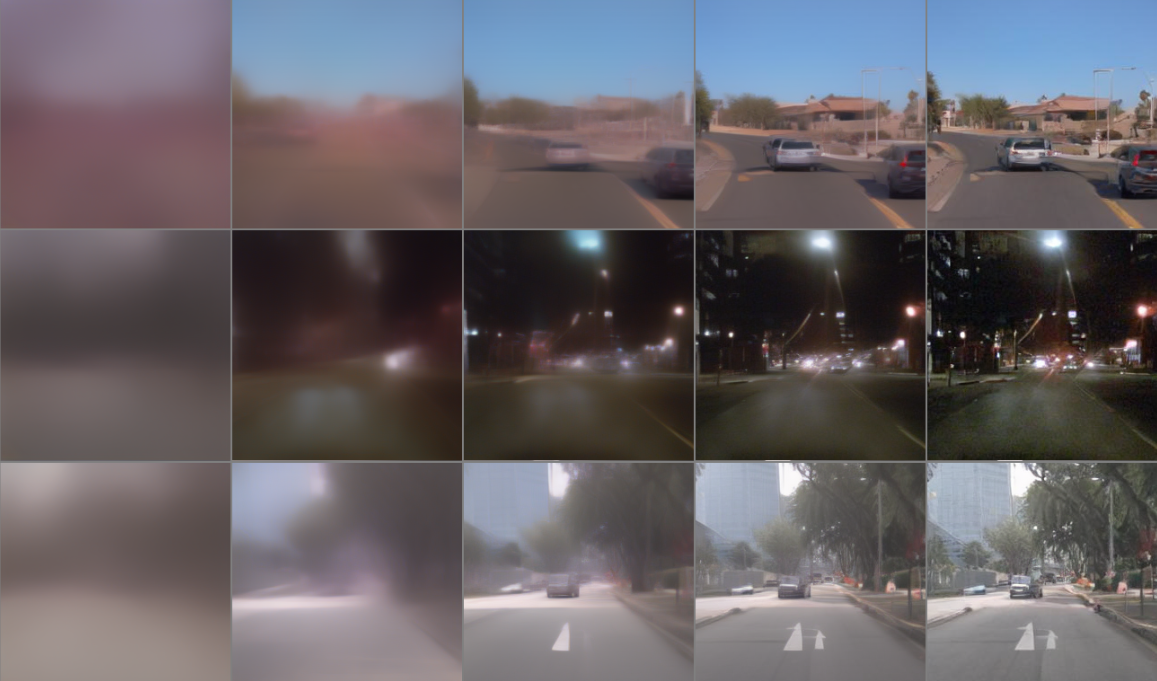 Figure 1: Backward process of latent diffusion model generating street scenes. Leftmost column shows starting noise; rightmost column presents synthesized images after training on autonomous driving data.
Overview
Collecting autonomous driving data is expensive. It takes a long time to deploy a vehicle across diverse environments, process the data, and apply it to downstream perception tasks - such as object detection, classification, segmentation, and tracking - for a self-driving vehicle (SDV). Furthermore, this data collection is financially-intensive. While there are many autonomous driving datasets, they are limited in geographical diversity (many with a focus on San Francisco). In short, it is impractical to collect numerous geographically-diverse datasets and thus difficult to promote sufficient diversity in training an SDV, which is important to generate robust self-driving cars.
Recently, there has been significant research in using generative technologies to create image data. This includes variational auto-encoders (VAEs), generative adversarial networks (GANs), and diffusion model (DMs) - each with their own flavours. Diffusion models are known to be the most stable of existing options. Therefore, our problem statement is:
Objective
Generate artificial AV images to improve robustness in a downstream perception task. More specifically, explore using diffusion models to generate the images and test whether a diffusion-augmented dataset improves object detection.
Data Centric Approach
The first step is creating a baseline, which generates new images without using generative models (e.g., DMs). Initially, my work entailed running many simulations that generate artificial datapoints (instead of datasets) in a simplified use-case using a toy dataset and a strategy that doesn't have anything to do with the parameters of diffusion models. I call this a "data-centric" approach, which constructs a lower-dimensional embedding of an original dataset (eg. using PCA), finds empty "pockets" in the embedding space, and inverse transforms these pockets into the higher dimensionality of our original dataset.
Formally, we fix a tabular non-image dataset, namely (D) (which ideally represents a driving image dataset). Then we construct a lower-dimensional embedding of (D) (e.g., using PCA), (D' = \text{PCA}(D)) with the intent of finding empty "pockets" (P) in (D'). Once they're identified, we inverse transform them back to the original dimensionality of (D), that is: (P = \text{invert}(P)). Then, we construct an augmented dataset (A = D \cup \text{label}(P)) using a semi-supervised algorithm (\text{label}), and compare performance.
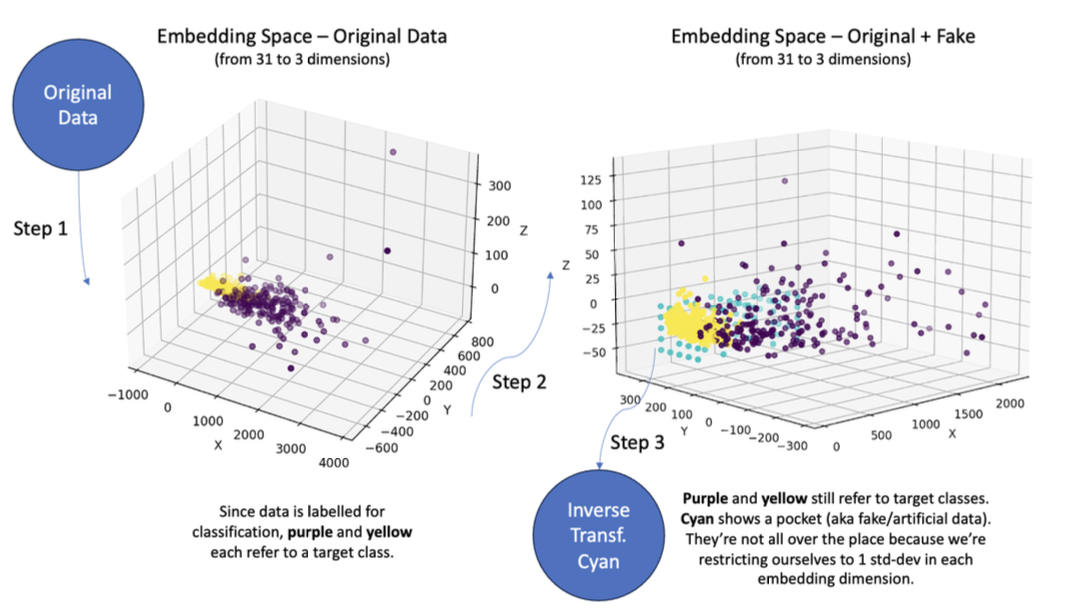 Figure 2: Data-centric approach visualization. Yellow and purple represent target class labels; cyan shows candidate "pockets" in embedding space. Rare cases show 4-5% test accuracy improvement with augmented artificial data.
These pockets are subsequently ranked for usefulness and sequentially augmented with the original data, after which performance w/ and w/o augmentation on a downstream task (eg. classification) is observed. I've noticed that very rarely does artificial data – at least the way I'm generating it – help with a downstream task (in this case classification), but in a few special cases, it nevertheless does!
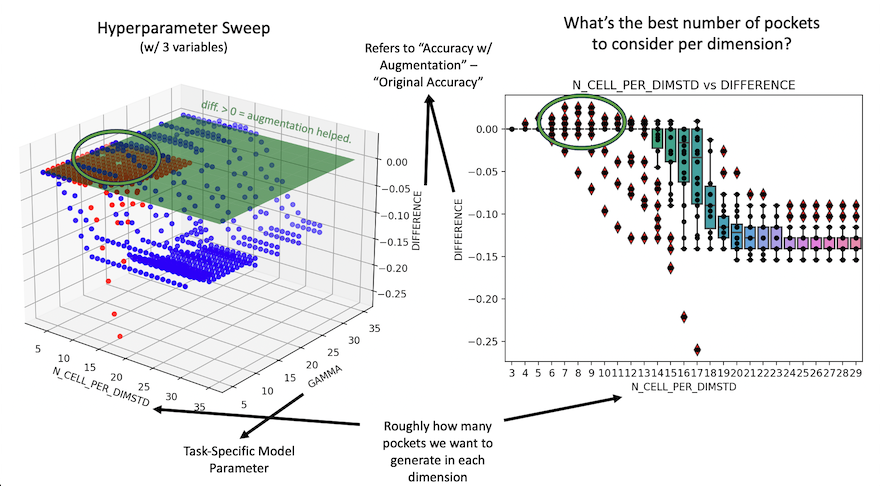 Figure 3: Classification performance comparison with and without pocket-based augmentation, demonstrating the selective utility of synthetic data generation.
This exploration shows that some parts of my data-centric approach of generating artificial data (much of which is applicable towards the other "model-centric" of generating artificial data) hold promise. The next steps are to train some diffusion models on driving data and test out this "pocket-finding" approach on an embedding of diffusion model parameters!
Model-Centric Approach
Given (n > 1) AV image datasets, and (i \in [0, n]), the next step is to train a (\text{DM}i) for each driving dataset (\mathcal{D}_i) and test out the "pocket-finding" approach given a set of datasets (\mathcal{D}{\text{META}} = {\texttt{embed}(\text{DM}i)\mid\forall i \leq n})! Note that we use _latent diffusion models instead of original DDPMs for computational efficiency which diffuse on VAE-latent representations.
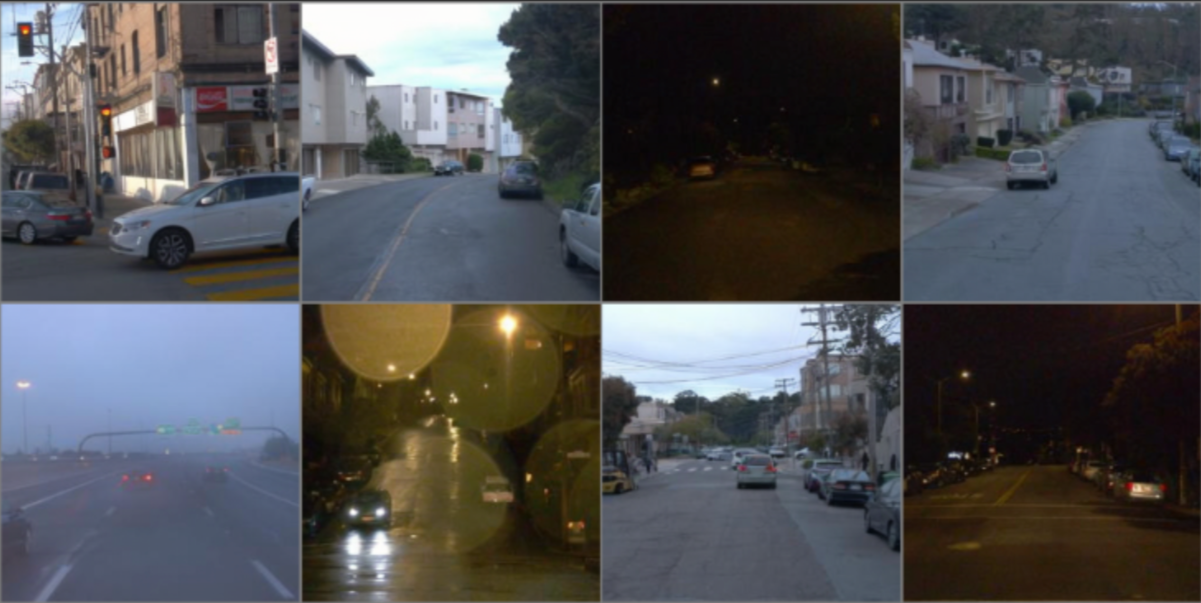 Figure 4: High-fidelity VAE reconstruction examples. Latent diffusion models operate on these compressed representations for computational efficiency compared to raw image space.
Results and Next Steps
Actually applying the pocket-finding approach on diffusion models is quite complex and immediately unrealistic – diffusion models, even latent diffusion models, have an enormous number of parameters. Pocket-finding in such a high-parameter space, or even a lossy embedding of this space (not to mention the non-negligible loss of information were one to do this), is intractable. Ultimately, my collaborator and I have architected some methods to make out final goal – to generate new, out-of-distribution autonomous driving datasets – much more tangible. I'm intentionally leaving out some of the details here given the work is in-progress, but here's an image of a diffusion model trained on the Waymo dataset (the same one from the top).
Figure 5: Latent diffusion model reverse process trained on Waymo and Nuimages datasets. Trained for ~48 hours on 2-4 V100 GPUs, progressively denoising from random noise (left) to coherent street scenes (right).