Collaborated with Kanghoon Lee, Jiachen Li, and David Isele at Honda Research Institute
Was previously working on a paper, not releasing the technical details just yet. Perhaps publishing. If you want to discuss the math and code with me, please contact me!
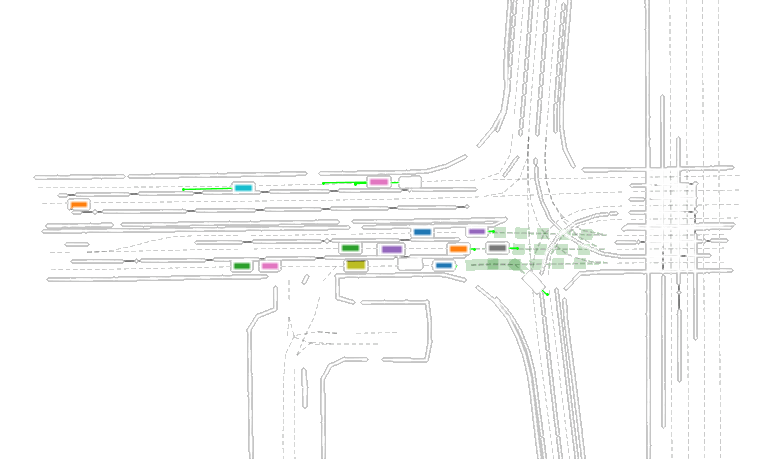 Figure 1: Single frame from Waymo Motion Dataset showing ego vehicle (center orange) and perturbed social vehicle trajectories. This visualization demonstrates our approach to introducing controlled diversity in autonomous vehicle training scenarios.
But here's something quick in-case you're really wondering.
Introduction
Reinforcement learning has proven to be a useful paradigm to autonomously train a car (known as an ego vehicle) how to drive. However, such vehicles often collide with other vehicles on the road (known as social vehicles) due to an inability to generalize to unseen situations. Unstable ego policies can result in dangerous scenarios. In short ego policies struggle to handle out-of-distribution traffic scenarios (such as complex social vehicle interactions it has never encountered before). Hence, it is of absolute importance to the diversity of data an ego vehicle experiences during train-time to avoid sub-optimal performance in test-time.
Objective
Train an ego vehicle in such a way that it is able to robustly and reasonably handle out-of-distribution scenarios. More specifically, discover a way to systematically introduce diversity in the ego training process without sacrificing performance (eg. number of collisions).
🚧 still working on this page (come back later) 🚧